
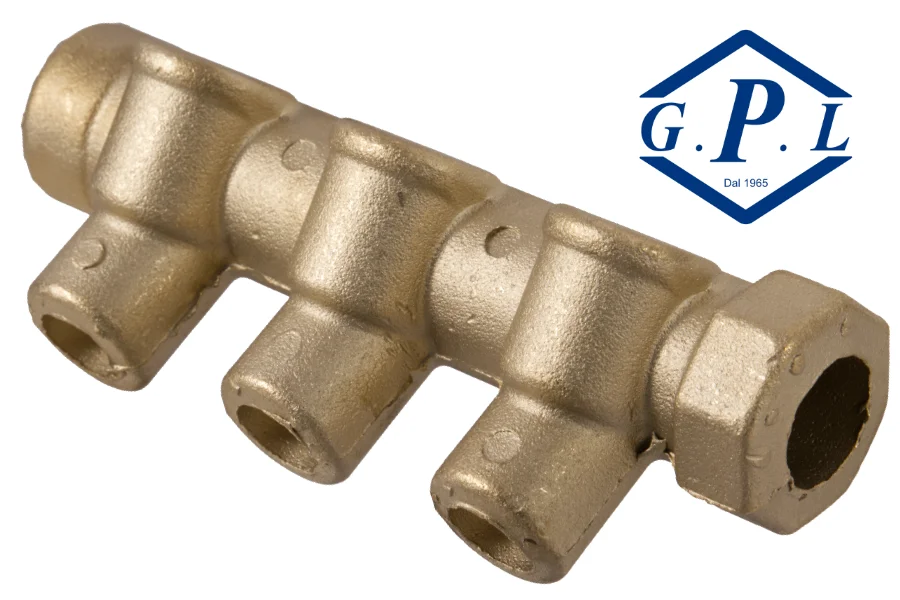
The most modern company engaged in hot forging of brass components, utilizing the most advanced technologies, actually addresses an ancient need: that of giving metal the desired shape.
Hot Forging of Brass Components: Historical Background
Metallurgy has evolved over the centuries, and the progress made over time documents the evolution of this particular production process.
The history of hot forging of brass components is, in a sense, the history of metallurgy itself.
Brass is an alloy composed primarily of copper and zinc, metals that were already worked in Roman times. The term “minting coins,” which we have all heard at least once, therefore also refers to the hot working of this alloy.
In the Middle Ages, the figure of the bronze worker emerged, who developed refined knowledge of the thermal properties of brass. This artisan guild jealously guarded the secrets of the trade, namely the processing methods, particularly the optimal temperatures at which effective work could be performed. The technological challenges focused on one particular aspect: the mass production of identical pieces.
It was with the Industrial Revolution between the late 18th and early 19th centuries that saw the decisive adoption of brass for the production of taps, valves, fittings, and also architectural decorations.
Toward the end of the nineteenth century, specialized industrial areas developed in Italy, among which
we recall the district of Brescia, Val Trompia, Valle Sabbia, and particularly Lumezzane.
Technologies have evolved, benefiting from the technological advances that were achieved in the meantime:
- new types of heating furnaces
- increasingly powerful hydraulic control presses,
- optimized die production techniques,
- automation of operations,
- introduction of numerical control in various processing phases
- brass bars with increasingly optimized alloys according to application (for example, low lead content for food applications)
The Hot Forging Process of Brass Components: Operational Overview
Hot forging of brass components has become an increasingly important industrial process over the years. Today it is the reference technique for obtaining components where quality, precision, and reliability are essential elements.
At the foundation is the raw material, namely brass: an alloy consisting primarily of copper and zinc.
Brass is supplied in optimized-size bars (so-called billets), and it is essential that it be of adequate quality. Gpl Eredi di Ghidini Pierluigi Srl uses suppliers of recognized reliability, with whom it collaborates continuously: the complete traceability of the brass used completes the overall quality profile guaranteed.
The Hot Forging Process of Brass Components: The Phases
1 – Heating
In the hot forging process of brass components, the brass is worked by first heating the bar to a specific temperature. It is important that the raw material remains within a well-defined temperature window in order to obtain perfect forging.
2 – Forging
The brass bar is positioned in the lower part of the die, positioning it precisely. The hydraulic press lowers the upper punch and, with controlled force, compels the brass to completely fill the die cavities. It is a very fast process that lasts less than one second.
3 – Deburring
Between the two die halves, it is normal for excess material to emerge, the so-called flash. Thanks to a specific punching die, the excess is removed in an operation called deburring.
4 – Cleaning
The brass components thus obtained are ready for subsequent surface cleaning and finishing operations.
Further details can be obtained by visiting our page dedicated to hot brass forging.
5 – Machining Operations
Hot forging of brass components is a perfect process for producing parts with particularly complex geometric shapes for special applications. This type of component normally requires very complex and articulated machining operations. The five-axis CNC machining centers with which Gpl Eredi di Ghidini P.Luigi Srl is equipped are perfect for ensuring quality consistency and minimal tolerances.
Hot Forging of Brass Components: The Machinery
1 – Presses
In the hot forging process, it is necessary to apply considerable force to close the die halves.
Various types of presses have been used in the past and can still be found in workshops today.
Eccentric mechanical presses: a type of press that was very widespread, which exploits the rotary movement of a shaft that is converted into rectilinear movement by a piston connected to the punch.
Hydraulic presses: which are controlled by a hydraulic circuit. These are presses that can apply very high pressures very precisely.
Screw or direct-drive presses particularly appreciated for forging specific types of parts.
2 – Dies
Dies are precision tools constructed using special steels that must withstand repeated stresses and hot forging operations of brass components. Gpl Eredi di Ghidini P.Luigi Srl boasts extensive experience and has developed considerable capabilities in die design, manufacturing, and maintenance.
3 – Punching Dies
Punching dies, used in dedicated presses, allow the removal of perimeter parts that are formed by excess material that emerged during the forging of brass components.
4 – Cleaning and Surface Finishing Equipment
Depending on the type of application required, the forged and deburred parts are then processed to obtain surfaces with defined physical and aesthetic characteristics.
The procedures include machining operations, chemical or electrochemical processes.
Hot Forging of Brass Components: Comparison with Casting or Die Casting
Casting, which can be permanent mold, sand, or lost wax, involves pouring molten metal into a dedicated mold. In die casting, molten brass is injected at high pressure into the mold.
Compared to these techniques, hot forging of brass components offers numerous advantages.
1 – Superior Mechanical Properties Hot forging produces components that are much less porous and with significantly superior mechanical strength, toughness, and fatigue resistance compared to cast parts. These advantages are decisive in the production of high-quality products, suitable for critical applications, manufactured homogeneously and machined with extremely high precision.
2 – Absence of Porosity. In cast parts, when the metal solidifies, micro-porosities, bubbles, and phenomena related to material shrinkage are inevitably generated. Forged parts, on the other hand, are dense and compact and are ideal for pressure applications such as fittings, valves, and pump bodies.
3 – Perfect Surface Finish Starting from a less porous and more compact surface, it is much easier to obtain perfect surface finishes suitable for critical applications.
4 – Hot forging of brass components presents much tighter dimensional tolerances compared to casting, reducing the need for subsequent machining operations.
Hot Forging of Brass Components: Product Types in Main Application Sectors
Taps and Valves
Certainly the most important sector by production volume, relating to hot forging of brass components, concerns the production of components for taps and valves: mixer taps, ball valves, safety valves, mixers, but also manifolds for plumbing systems. In these sectors, it is necessary that the components guarantee seal at operating pressures, demonstrate high corrosion resistance, and are characterized by a long service life.
Hydraulic and Pneumatic Components
Through hot forging of brass components, fittings, elbows, reducers, nipples, sleeves, nozzles, and fittings in general for hydraulic and pneumatic systems are obtained.
Components for Food Systems and Water Treatment
Thanks to the use of special low-lead brass alloys, hot forging of brass components makes it possible to produce a wide range
of articles intended for this type of system.
Bathroom Furnishings and Other Design Objects
Hot forging allows the production of objects with aesthetically refined shapes suitable for finishing through chrome plating, nickel plating, high-quality painting, or other surface treatments, e.g., PVD.
Hot Forging of Brass Components: What Added Value Can Gpl Eredi di Ghidini P.Luigi Srl Guarantee to Its Customers?
Ability to Manage the Integrated Hot Forging Cycle of Brass Components
The answer is simple: management of the integrated cycle, from die design to delivery of the finished component.
A perfectly forged part is one that benefits from maximum integration between forging operations and subsequent machining operations.
Experience
Our experience is fundamental in the integrated process of designing and manufacturing dies and related tools. Assisted by an effective prototyping phase, dies can be optimized and fine-tuned to ensure maximum productivity.
Innovation
The technologies developed and implemented by GPL Eredi di Ghidini P.Luigi srl allow, for example, forging articles without flash, in order to reduce material waste (scrap), and reduce the need for subsequent operations (deburring and related dies). This translates into considerable cost savings, to the benefit of our Customers.
Optimization
A correctly forged part, in a carefully optimized die, fits best into an equally optimized machining cycle. All this translates into time savings, cost savings, exceptional build quality, reliability of the components produced… and also punctual delivery!
Some Curiosities
What Are Brass Alloys Composed Of?
Brass alloys are composed primarily of copper and zinc. The alloy may also contain lead, tin, iron, silicon, aluminum, and manganese.
Is There Only One Brass Alloy?
There are many types of alloys, each of which is constituted with a different proportion of copper, zinc, and other metals. Each brass alloy, thanks to its specific properties, is particularly suitable for certain types of processing, for example casting, hot forging, cold forming… and excels in particular uses of the finished component.
Why Is Low-Lead Brass Important?
A separate consideration must be made for a very important special brass alloy: low-lead brass. Lead is normally added to brass alloys as it facilitates the machinability of components, but its presence is increasingly severely regulated by standards that certify the suitability of components for food contact.
GPL Eredi di Ghidini P. Luigi srl has developed specific expertise in hot forging of low-lead brass components, and today boasts significant production of components suitable for food contact. The NSF certification obtained and renewed guarantees compliance with the most stringent quality parameters for the food sector, starting from rigorously selected and traced raw materials.
At What Temperature Does Brass Melt?
Brass alloys commonly on the market melt at a temperature slightly above 1000°C. Further details on this page.
Is Brass Corrosion Resistant?
Brass alloys are renowned for their high corrosion resistance. Hot forging of brass components is the ideal process for obtaining fittings, valves, manifolds, and pipes ideal for critical applications.
Does Brass Oxidize?
The answer is affirmative. Although brass is very resistant, over time it still tends to deteriorate. The oxidation process creates a protective layer on the surface, identifiable as a typical greenish-bluish patina. This is a passivation process similar to that of stainless steel: the patina has a protective function and prevents oxidation from damaging the metal in depth, counteracting phenomena that would also lead to through corrosion.


